Mekhitar Garabedian’s work explores identity through the lens of migration and cultural heritage. Using diverse media—such as drawing, video, photography, and installations—he reflects on his experiences as an immigrant. His work plays with the mix of languages, cultures, and histories he has encountered, finding poetry in the overlaps. Just as his personal diasporic history is layered, his art is rich with references to literature, music, philosophy, and visual arts. Through these influences, Garabedian demonstrates that identity is not fixed, but shaped by memories, traditions, and the world around us.
Born in Aleppo (Syria) to an Armenian family that had already faced displacement due to the Armenian genocide, Garabedian moved, at a young age, with his parents to Belgium. This experience of movement between geographies and histories is central to his work. He explores themes of belonging and displacement, often using the Armenian language, old photographs, and written texts to preserve and reinterpret a past that is both personal and collective. His work illustrates that identity is not just about where you come from, but about the connections you make along the way, between inherited traditions and contemporary realities.
Garabedian also examines how cultures evolve over time. By blending personal stories with references from art and philosophy, he challenges ideas about where people belong and who they are. For many with migrant backgrounds, ‘home’ is not a single place but a mixture of memories, languages, and influences. Garabedian’s work encourages us to think about identity as a fluid, multifaceted concept, shaped by many factors, all of which contribute to making us who we are.
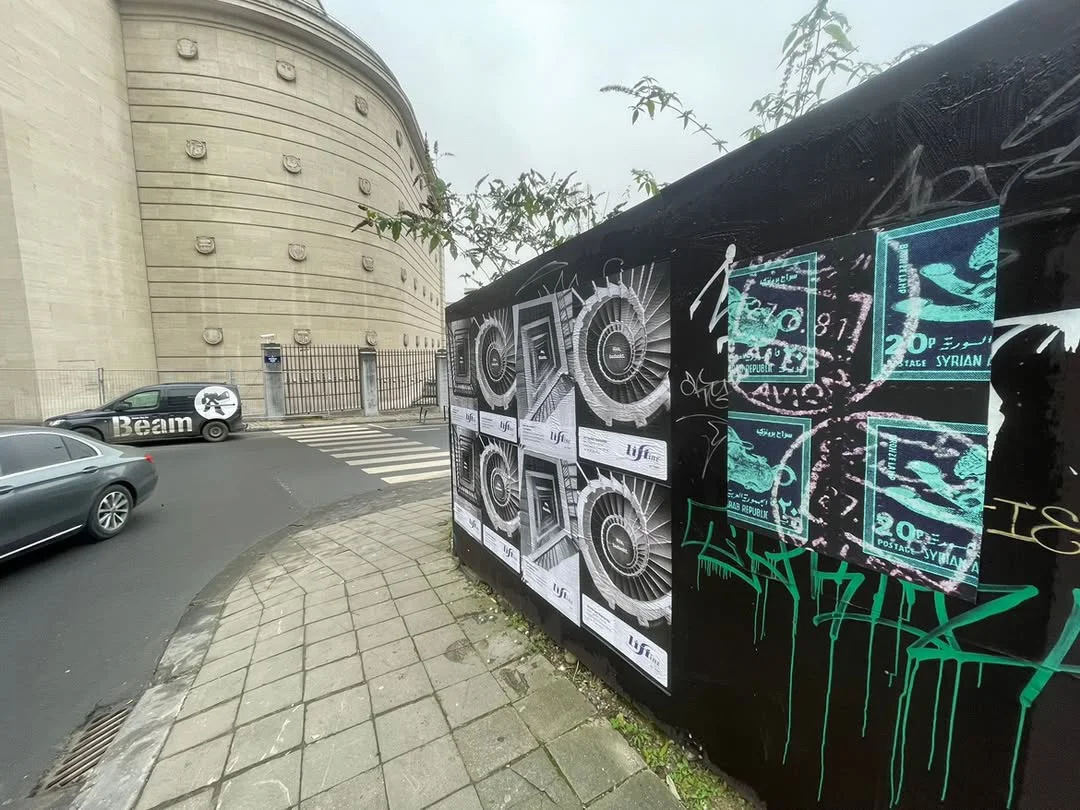
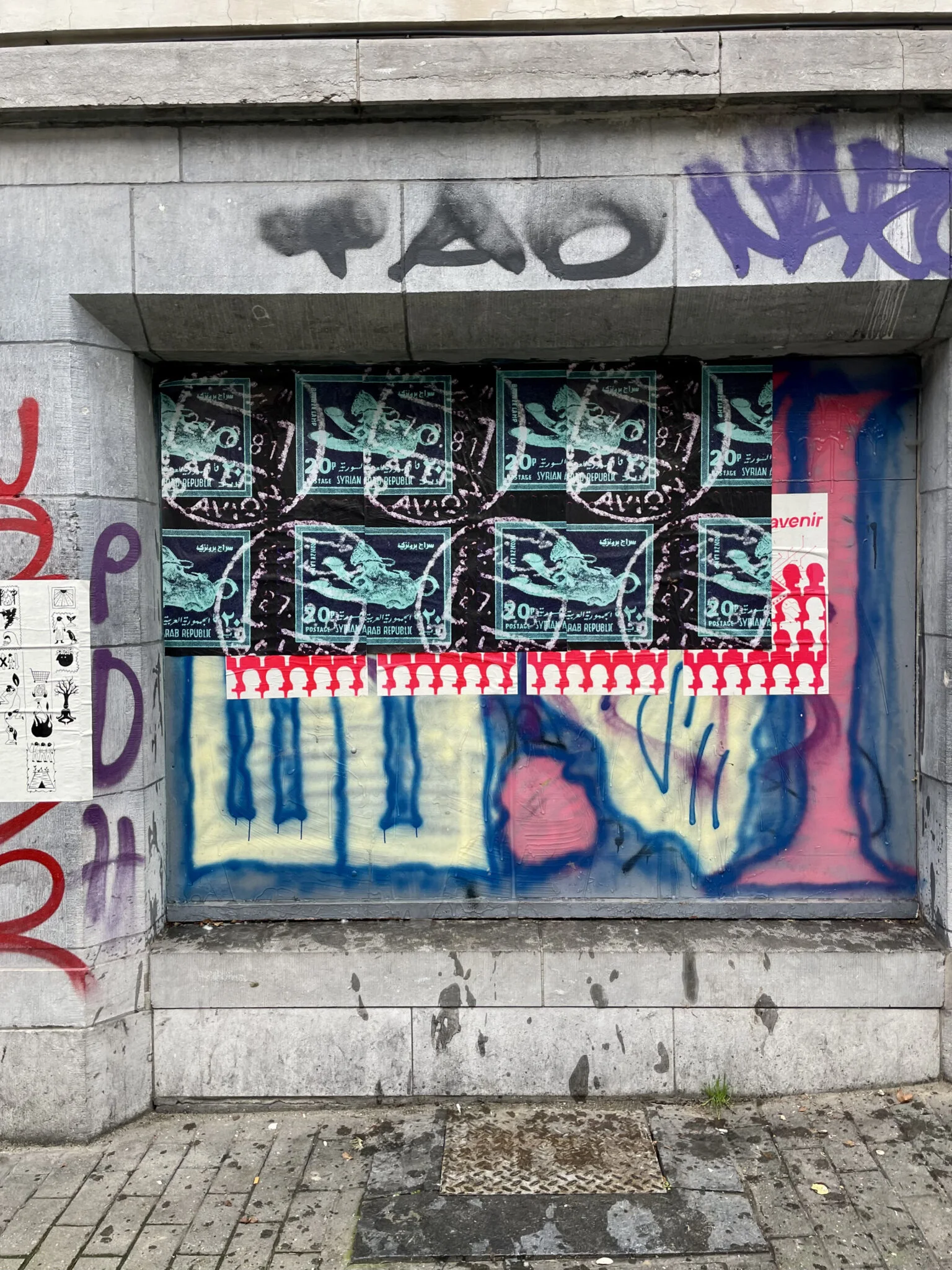
Alep (Bronze Lamp) features a Syrian stamp depicting a bronze lamp shaped like a horse, overlaid with “par avion,” “Alep” (in both French and Arabic), and the date 27.08.’81. This date marks a personal history—Garabedian was born in Aleppo and emigrated with his family to Belgium in 1981. The stamp comes from a letter sent to his father in Antwerp, where the family lived during their first year in Belgium. Part of a series issued in Syria in the late seventies, the stamp depicts heritage objects from National Museums. Garabedian alters the image, making it feel distant and unreal. By inverting the colours of the original stamp, he removes it from view, emphasising its inaccessibility—just like aspects of the past that remain out of reach, preserved yet transformed by time and memory.
Just as the stamp represents a fragmented connection to the past—altered and partially obscured—its placement as an image in public space, as part of the PLAKT series, mirrors the transient nature of memory, migration, and cultural identity. Passersby may or may not recognize the stamp’s origins, just as the histories carried by migrants often go unnoticed in public spaces. The altered colours reinforce this sense of distance—what was once a personal marker of communication is now a ghostly imprint. This challenges viewers to consider what is lost, preserved, and reshaped over time.
For PLAKT, artlead invited twelve artists to create work that has been distributed as prints throughout various Flemish cities and Brussels since the end of 2024. These images are distributed by professional posters. By working with them, artlead relinquished control: the posters determine where and when the artworks appear. The images pop up in unexpected places and disappear just as quickly, reflecting the elusive and fleeting nature of city life. Just as moments come and go without warning, art becomes part of the rhythm of the city: sometimes unnoticed, sometimes totally surprising.
Working with artists can sometimes be unpredictable. Instead of a sculpture, French artist Valérian Goalec preferred to create a carrier: a steel wall sculpture based on the advertising frames he sees every day in the Paris metro. Because it is impossible to simply install these steel frames in public spaces, a second section of PLAKT was unexpectedly created. To this end, artlead is collaborating with various cultural institutions, including the Brakke Grond, which are located on the geographical periphery, where the images have not previously appeared in the streetscape. These partners are welcoming Goalec's wall sculpture for an indefinite period of time, which serves as a carrier for the images of the other eleven artists.
Every month, one artwork will be unveiled in a unique way at the Brakke Grond on the square. This artwork can then be admired day and night for a month. Keep an eye on our website, newsletter, and social media!