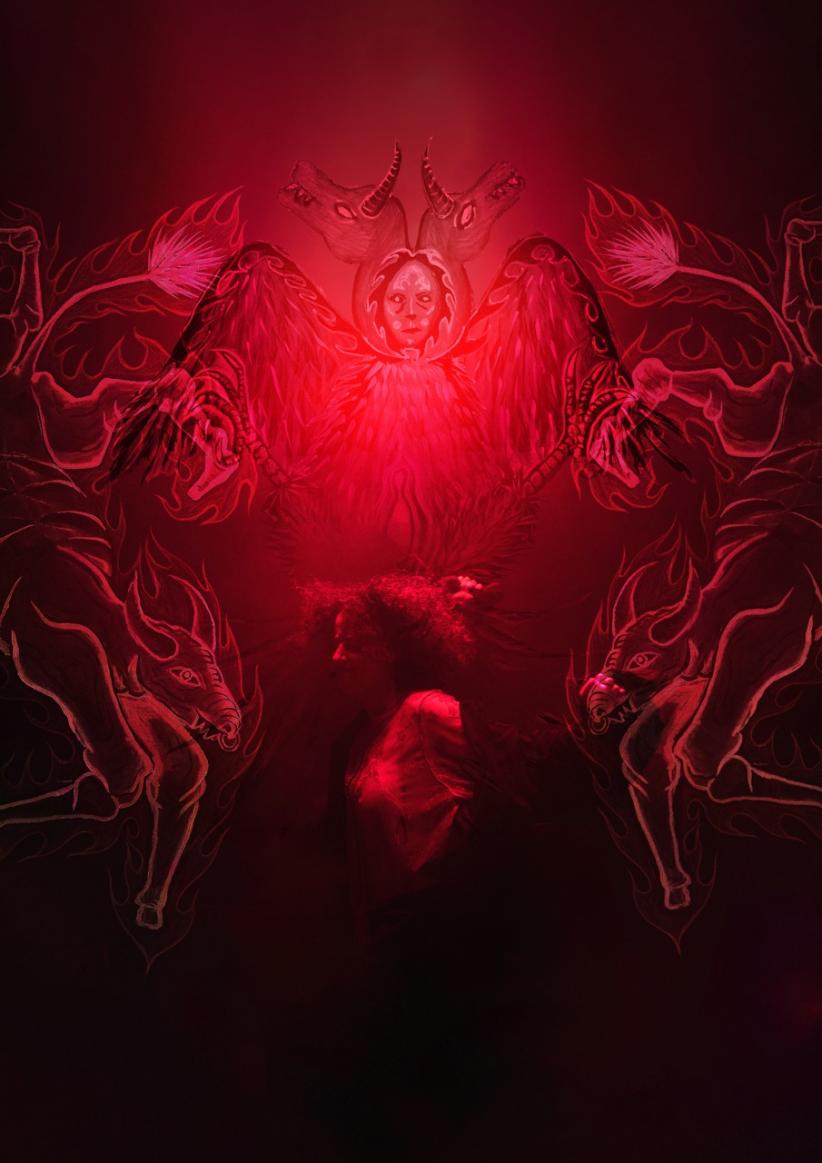
SHRINE is an immersive theatre performance that tells the story of a Daughter who seeks refuge with the Jinns, non-human beings, in a parallel world. She, the Daughter, carrying the greatest pain and grief, is wanted by the government. Her mother has been brutally murdered by systems sustained by humans and powers. The Daughter is witness to this killing, she has seen it with her own eyes, the horrors of how her mother is murdered, she will never unsee. She chooses to fight fairly for justice and follows the steps of the constitutional state. After years of fighting for justice, she becomes weary. Her anger and grief radicalise her in our capitalist world. Her radicality has led her to set fire to embassies, town halls, parliament, palaces, police stations, courts, prisons, private banks, oil companies, petrol stations and many other government buildings and businesses. Her actions have always caused material damage; there have never been any deaths or injuries. The government is trying to find out with whom she acted, as they do not believe she could have done this alone. The grief and injustice that has taken up space in her body, transformed into anger. This is where she drew all her strength to create chaos and disrupt the economy.
‘I acted alone with the protection of my mothers’ mothers, my great-grandmothers and their great-grandmothers carried and protected me. I have shown and made the most powerful in these systems feel and fear me. Now they know how powerful I am, thanks to God.'
Her actions motivated many women in other countries in Europe and America to do the same. She hid in the desert for a long time, where she met the Jinns. They offered her refuge in their dimension, in their SHRINE. Here, her grief and anger are celebrated and the grief she carries is given all the space to be and to be expressed unsubtle, freely.
There is remembrance, prayer, chanting, sacrifice and celebration.
Departing from Silvia Federici's essays, El Kharraz Alami, once again shows how she transforms essayistic work into an act and finds forms to make tangible the role of marginalized women in our societies. This creates alienation and social inequality and she shows where the struggle for radical equality determines a women’s position in society.
What erased roles of women in societies can we reanimate and what buried cries will be heard?
In Federici’s essay Caliban and the Witch, she shares the role of women in the context of the transition to capitalism and the impact on social structures that still exist today. She emphasises that during this period women often played a crucial role in the reproduction of labour power, both domestic and productive. Changes in the economy and social relations in the 17th century had profound effects on the position of women, resulting in increased dependency and marginalisation.
The history of Europe before the Conquest is sufficient proof that the Europeans did not have to cross the oceans to find the will to exterminate those standing in their way.
Silvia Federici
Federici refers to the history of Europe before the colonial conquests, which already included violence and oppression against different groups and women. She argues that the tendency to violence and extermination of opponents is not new to Europeans. It implies that the motivation for such acts is already deeply rooted in European history, and that colonisation and the associated exploitation and violence stem from a pre-existing culture of domination and oppression. In SHRINE, El Kharraz Alami speculates through critical fabulation about a future that has already begun.