Ticketinfo

de Brakke Grond
Data vr 22 mei — za 20 jun
13:48
Prijzen
Language no problem
Toegang is gratis, een donatie is welkom
Expositie

Tentoonstelling FIBER Festival 2026

Fragile Forces

Exhibition FIBER Festival 2026

Nine artworks that offer various perspectives on the
concept of fragility


Linked to the theme Fragile Forces, the Amsterdam-based arts organisation FIBER presents two interconnected exhibitions under one roof: Fragile Resonances and Fragile Terrains. The exhibitions form part of the annual FIBER Festival. The separate sections function as two chapters, each inviting us in its own way to reflect on the concept of ‘fragility’ as a strength, rather than a weakness. One through sound art and ways of listening, the other through the vibrancy of matter.


Participating artists: Aldo Brinkhoff, Anaïs Lossouarn, Robin Koek & Jean-Emmanuel Rosnet, Sunjoo Lee | AYO, Brahim Tall, Franziska Windisch, Mariska de Groot, Mike Rijnierse & Rob Bothof


Part 1: Fragile Resonances

A sonic encounter between Dutch and Belgian sound artists

May 22 till June 20, 2026

de Brakke Grond


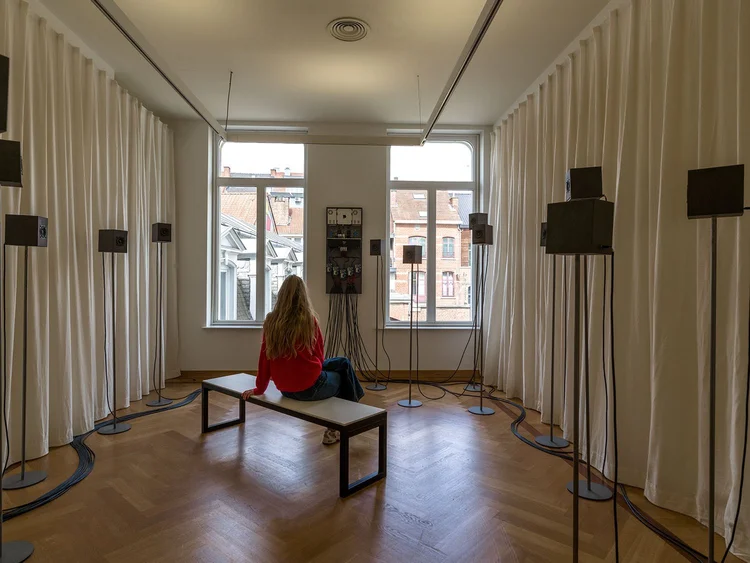
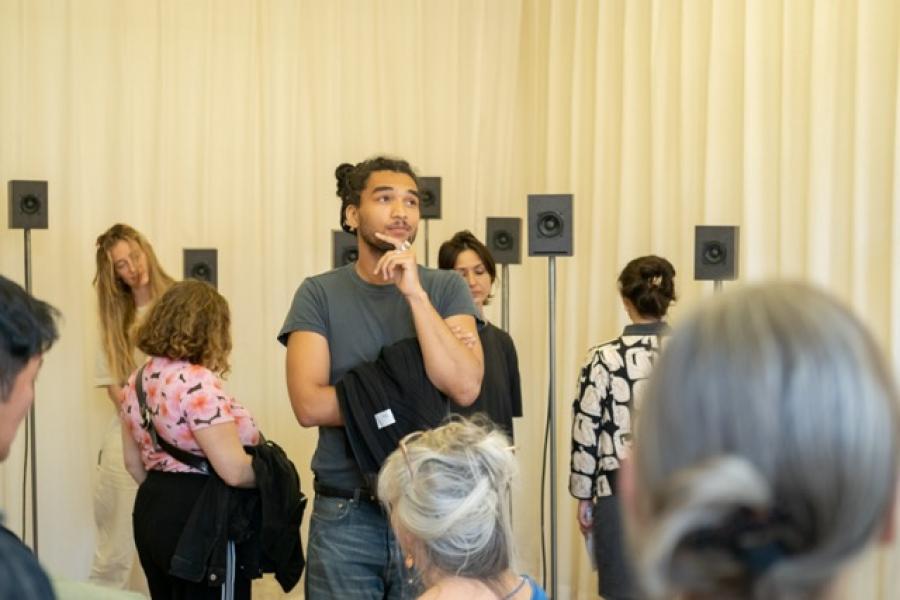
Fragile Resonances brings together work by five sound artists based in Belgium and the Netherlands who invite us to slow down, draw closer, and listen. Their practices stem from a shared sensitivity to sound as something that is not only heard, but also moves, connects, and unfolds within space.

The works stem from a fragile, sometimes barely perceptible source – such as the vibration of a chain, a whispered voice, or a play of light. Through accumulation, repetition and interference, these micro-events grow into layered, immersive compositions. What begins as small and individual unfolds into a complex whole in which order and chaos, control and unpredictability constantly intersect. These become layered, emotional sound experiences that allow us to realise that a sum of small elements can lead to powerful changes. And that, beyond our immediate perception, there are often far more complex relationships woven into our living environment.


Selection of works

SO(N)R (2026), AYO

The Choir of Dissonance: The Creation of the Sea (2025), Brahim Tall

On Random Walks (2025), Franziska Windisch

Incidence of Light (2019), Mariska de Groot

Piano / Forte (2018), Mike Rijnierse & Rob Bothof


Opening times

Tuesday – Sunday, 12:00 – 17:00 | de Brakke Grond

Opening: 22/5, 19:00


During the festival weekend

Thursday 28/5: 10:00 - 22:00

Friday 29/5: 10:00 - 20:00

Saturday 30/5: 10:00 - 20:00

Sunday 31/5: 19:00 - 20:00


Curators: Jarl Schulp (FIBER), in collaboration with Gilles Helsen (STUK) and Mirthe Demaerel (de Brakke Grond).


Part 2: Fragile Terrains

May 22 – 31, 2026


Selection of works

Thixocymatics (2026), Aldo Brinkhoff

Ce que la pierre retient du vivant (What the stone holds of the living) (2026), Anaïs Lossouarn

Garden of Mnemonics (2026), Sunjoo Lee

De glace et d'eau (2026), Robin Koek & Jean-Emmanuel Rosnet


Opening times
Tuesday – Sunday, 12:00 – 17:00 | de Brakke Grond

Opening: 22/5, 19:00


During the festival weekend

Thursday 28/5: 10:00 - 22:00

Friday 29/5: 10:00 - 20:00

Saturday 30/5: 10:00 - 20:00

Sunday 31/5: 19:00 - 20:00


The work De glace et d'eau by Robin Koek & Jean-Emmanuel Rosnet can only be viewed from 28 to 31 May, subject to a time-slot ticket. Time-slots will go online soon.


Curator: Jarl Schulp


SO(N)R

AYO


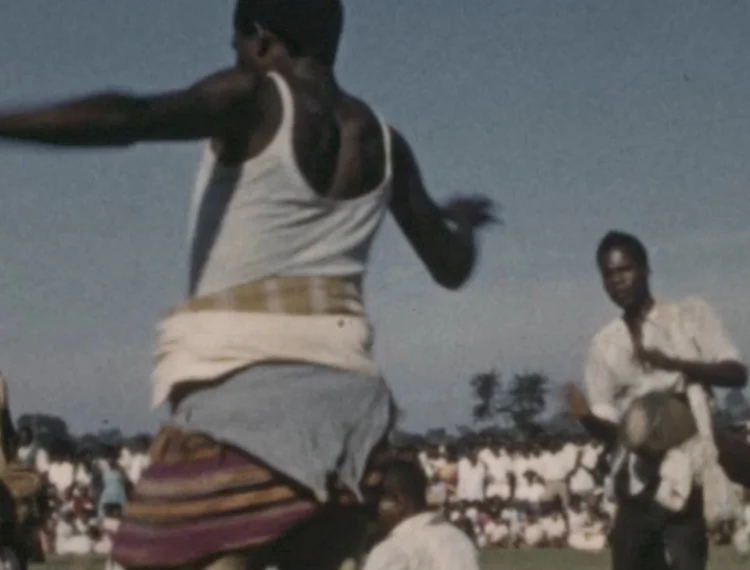
SO(N)R (2026) is an ever-evolving work, currently comprising a film and a selection of instruments, in which the material nature of sound aids in the recollection of history. AYO combines a 1960s archive of 8mm amateur film footage from Uganda, Kenya and Tanzania with an interpretation of a traditional instrument: the Abu. This Luo wind instrument was used to announce a death within the community. However, as no recordings of the Abu’s original sound are known to exist, AYO, together with master glassblower Gert Bullee, created a series of mouth-blown glass interpretations of the instrument. 


The archive footage was filmed by a former Shell employee and, within its colonial context, contains unique recordings of life at that time. What is missing, however, is the sound. Rather than viewing the lack of sound archives as a limitation, AYO saw this as an invitation to determine the sound themselves (and reclaim it). In collaboration with musician Yanik Soland, they composed a new soundtrack for Abu, using fragile sound experiments to bridge the gap between past and present.


AYO (Christine AYO) is a multidisciplinary artist who grew up in Kampala and is based in Rotterdam, who works with sculpture, sound, performance and film. Through time-based and collective works, she explores how intangible cultural heritage, such as language, memory and indigenous knowledge systems, embeds itself within and against material forms, thereby opening up spaces where history comes to life, is shared and is sometimes misunderstood.


The Choir of Dissonance: The Creation of the Sea (2025)

Brahim Tall


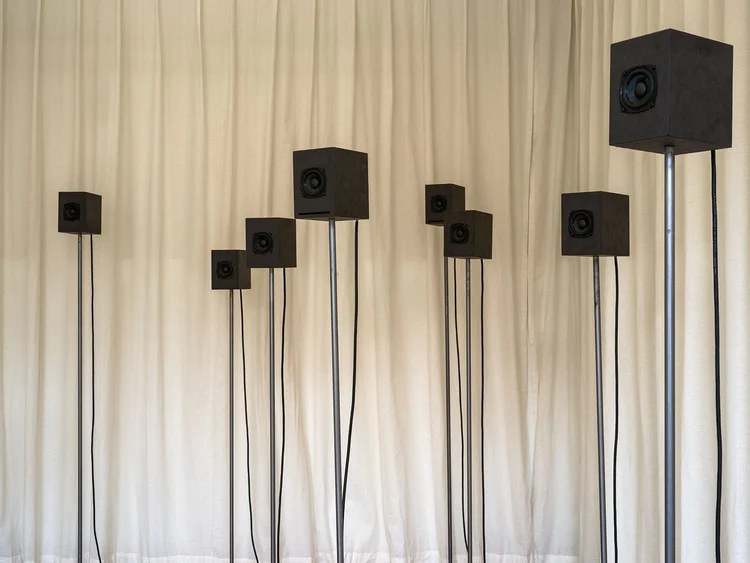
The Choir of Dissonance: The Creation of the Sea (2025) is an installation that listens just as much as it speaks. When there is no movement in the room, whispering can be heard. As soon as someone enters or moves, individually recorded voices build up and wash over the space. What begins with various recordings in English, French and Portuguese gradually comes together in a melodious choir. This creates an ever-changing soundscape, like a sea without a fixed form, in which harmony and noise constantly merge, allowing visitors to move at their own pace.

The work, which stems from a previous performance, explores the voice as a medium that is both fragile and powerful, moving between the intimate and the collective. It reveals how individual expression can grow into shared power, with language, memory, identity and expression merging into a single living whole.


Brahim Tall’s practice examines the Black body in relation to media production, and the ways in which media both generate, shape and impact the Black experience. In his research, the artist focuses on the gazes historically produced by this relationship and attempts to disrupt and transform them by shifting their aesthetics. Rather than focusing on a single specific medium, he uses a wide range of mediums like film, photography, video installation, audio installation and performance. Tall’s works are in a constant ongoing process that shifts between these mediums and activates different visual languages to address the way we read and interpret the Black body. In this way, he attempts to lift the veil on the mechanisms behind our naturalised interpretation of media and the conflicting biases within our gaze.


With the voices of: Aghogho (Caro Abutoh), Aïcha Ouattara, Ashley Morgan, Brahim Tall, Emeraude Tshidibi Kabeya, Fahad Seriki, Fred Gata (Frédérick Nizeyimana Gatabazi), Gabriel Eden, Jonathan Rwaka Rutayisire, Joram Kunde Boumkwo, Junior Akwete, Kamal Tall, Kenny Mala Ngombe, Keziah Morris, Lou Cocody Valetino, Martha Canga Antonio, STACE, Uwase (Anaïs Rutayisire), Zindzi Tillot Owusu

Music composed by: Lisa Wambacq

Audio Design: David Dubois


On Random Walks

Franziska Windisch


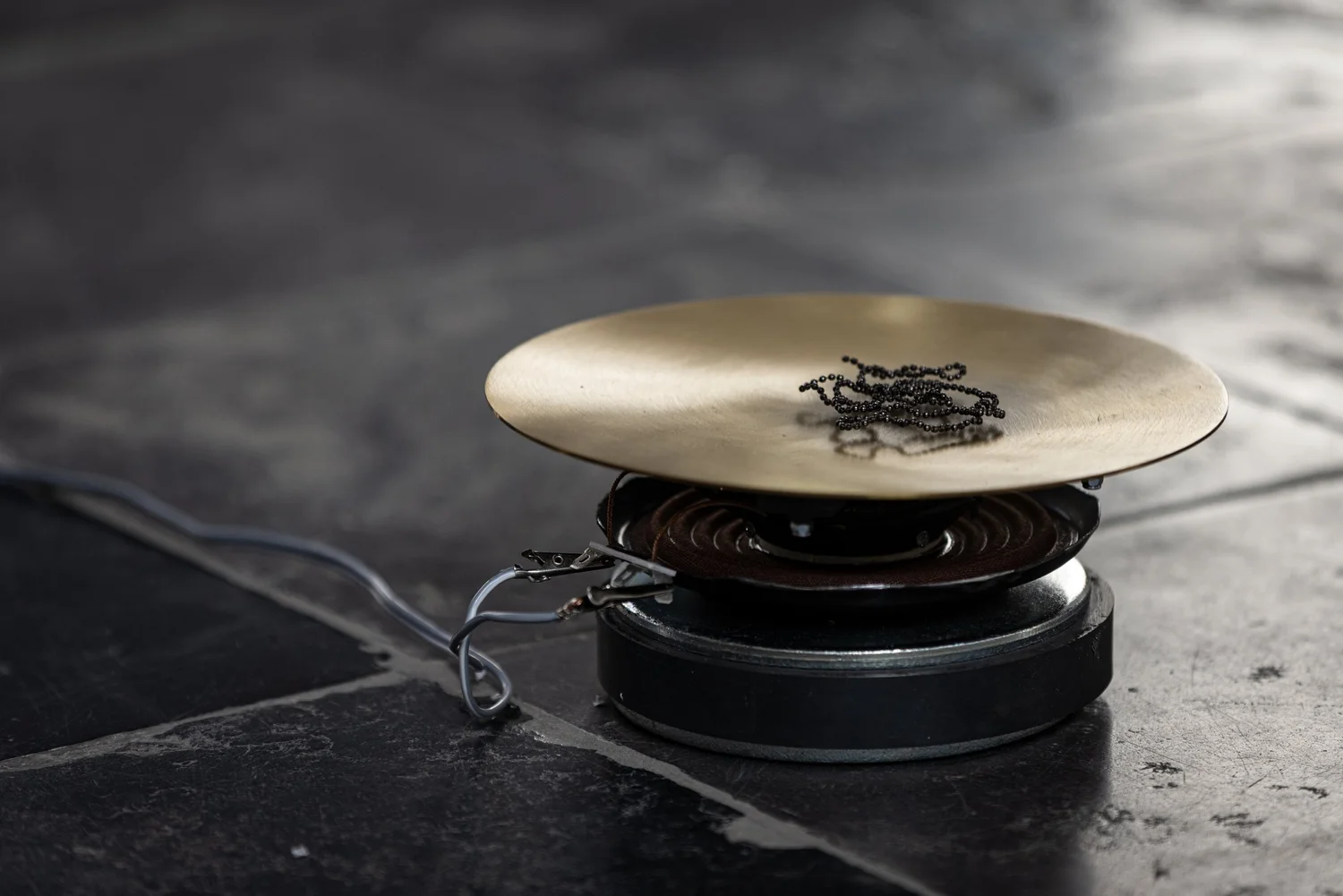
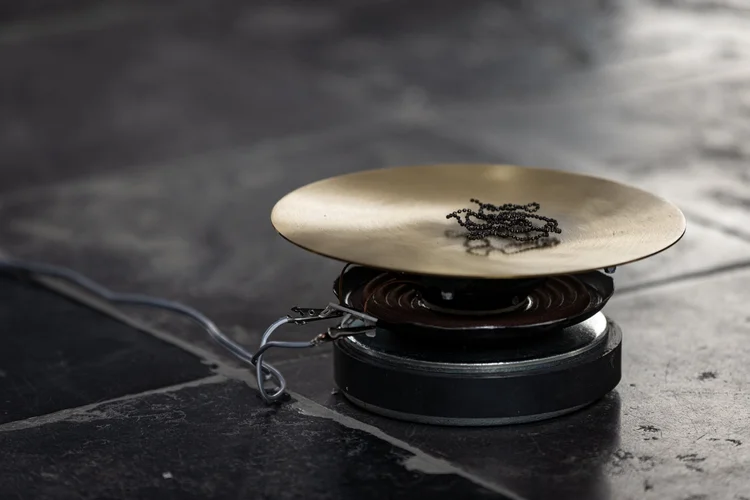
On Random Walks (2025) by the Brussels-based artist Franziska Windisch is a sound installation in which vibrating chains oscillate between order and unpredictability. Set in motion by inaudibly low frequencies, they generate rapidly changing patterns, creating temporary knots that dissolve almost immediately. This is reminiscent of how, in physics, these so-called ‘granular chains’ are used as a model to study the behaviour of filamentous structures such as DNA, RNA or polymers. 

The moving chains, in turn, gently strike the brass plates, creating a pulsating field that constantly shifts and sounds different as you change your position. What appears small and simple thus reveals a continuous dynamic of change that accumulates into complex, spatial compositions. Sound connects these processes: the inaudible vibrations set the material in motion and, through subtle touches, generate a pulsating sound field.


Franziska Windisch is a sound artist and lecturer based in Brussels, working across performance and installation. Her practice centres on processes of transformation and perception, creating situations in which sound, movement, language, and material enter into shifting, poetic relations. Moving beyond representational modes, Windisch develops scores as open structures, where internal states and external conditions interact and unfold over time. Listening into matter, places and situations, her work is dedicated to processes of transformation and perception.


Production of Overtoon Brussels and STUK Leuven, with the support of the Kunstendecreet Vlaanderen


Incidence of Light

Mariska de Groot


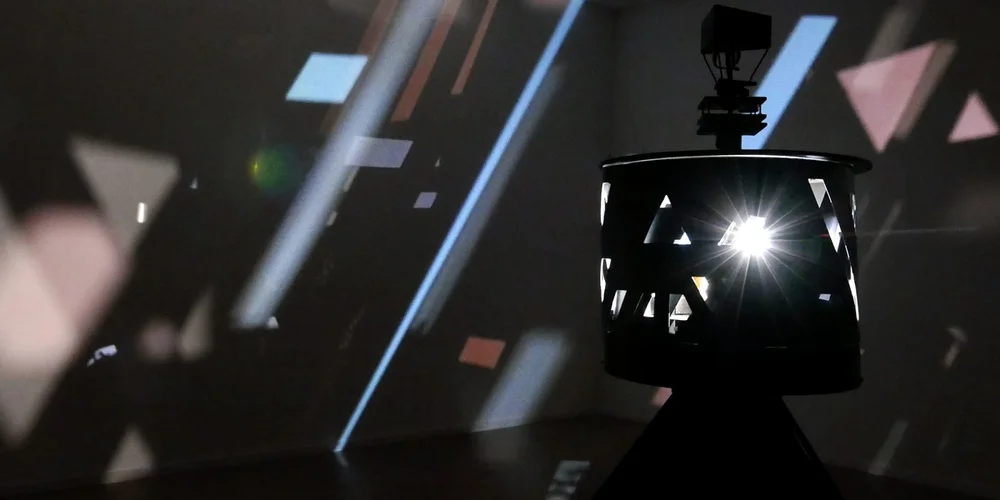
Incidence of Light (2019) consists of raw, rustling sounds with a distinctly mechanical quality, which growl and squeak. At times, the work evokes the sense of space of a busy street or the image of faint, urban light reflections on the windows of a moving car. At other times, we hear moving machinery or something reminiscent of an alarm. As the audiovisual composition unfolds, a 360-degree world opens up in which reflections and irregularities in the sound offer a poetic and immersive experience. It is the small glitches, the coincidences and the unpolished sounds that make Incidence of Light a unique experience – something that cannot be predicted or controlled. Shadows approach rhythmic silences, and shades of grey determine the volume. An experience in which seeing and listening continuously inform one another.


Mariska de Groot her artistic research into optical sound is a recurring theme; she works with light-to-sound scores and develops and plays kinetic projection instruments. These often consist of artistic feedback systems that arise between light and dark, shadows and reflections. Light patterns are detected by sensors, which in turn control the sound composition. This exploration of the subtle nature of optical sound and the synergy between visual and sonic dimensions has a rich history. It forms part of a long tradition of kinetic light sculptures, such as the Light-Space Modulator by pioneer László Moholy-Nagy.


Piano / Forte

Mike Rijnierse & Rob Bothof


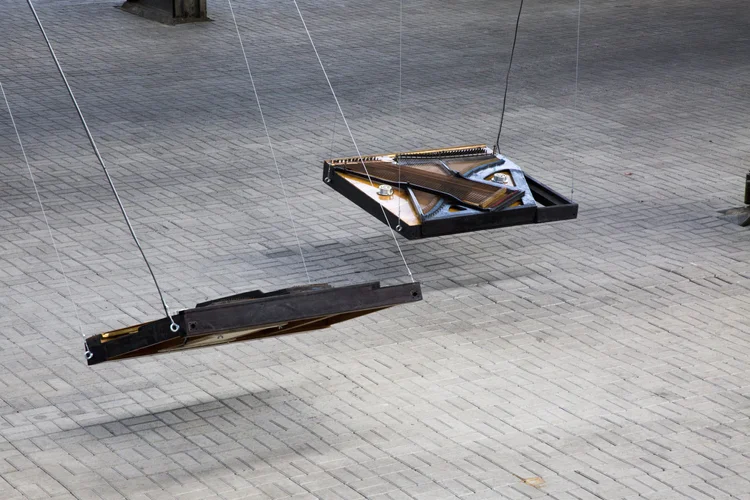
Piano / Forte (2018) consists of two dismantled pianos, leaving only the suspended piano harps after the keys and wooden frame have been removed. This is the instrument’s heavy heart, but apart from that, there is nothing left to strike the strings. Artists Mike Rijnierse & Rob Bothof introduce us to the piano in a new, trance-inducing way; by suspending the string mechanism like a pendulum and allowing visitors to set it in motion, a new world of sound, complete with reverberations and resonances, comes to life. It is not the striking of the strings that produces the familiar piano sound, but rather the translation of the movement, which is converted by software and electromagnets into vibrations that are played across the entire structure. This creates a new complexity of layered, subtle and alienating sounds, which we do not recognise from this traditional instrument. 

Like two pendulums, the sculptures swing in tandem and against one another, creating different phases and interferences. Whereas normally the material is entirely at the service of the perfect tone, we now listen to its free and unpredictable character, which grates and hums. In doing so, we experience how small interventions can set off broad sonic resonances.


Mike Rijnierse is an artist, inventor, curator and lecturer who transforms light and sound into spatial experiences. His practice focuses on composing with and for the environment, in which he regards exhibition spaces as an integral part of the work itself. Historical and media-archaeological research often serves as an important starting point in his practice.


Rob Bothof is a creative programmer, artist and engineer. He works at the intersection of instrument making, machine interaction, autonomous systems and sound. His practice ranges from algorithmic systems to audiovisual composition, and consistently asks how technological structures can leave room for expression and openness.
 

Location de Brakke Grond
Data vr 22 mei — za 20 jun
13:48
Buy tickets

Tentoonstelling FIBER Festival 2026

Fragile Forces

© The Choir of Dissonance: The Creation of the Sea (2025), Brahim Tall

Expositie

Tentoonstelling FIBER Festival 2026

Fragile Forces
Negen kunstwerken die verschillende perspectieven bieden op het concept van kwetsbaarheid.

Feestelijke opening

Op vrijdag 22 mei openen we feestelijk de deuren van de tentoonstelling. Je bent van harte welkom vanaf 19:00 uur


Programma: 

19:00 Deuren open 
20:00 Openingswoord en artist talks 

Gratis toegang. Graag even aanmelden via deze link


In het kader van het thema Fragile Forces presenteert de Amsterdamse kunstorganisatie FIBER twee onderling verbonden tentoonstellingen onder één dak: Fragile Resonances en Fragile Terrains. De tentoonstellingen maken deel uit van het jaarlijkse FIBER Festival. De afzonderlijke delen fungeren als twee hoofdstukken, die ons elk op hun eigen manier uitnodigen om na te denken over het concept ‘kwetsbaarheid’ als een kracht, in plaats van een zwakte. Het ene door middel van geluidskunst en manieren van luisteren, het andere door de levendigheid van materie. Samen met FIBER Festival en STUK Leuven presenteert de Brakke Grond: Fragile Resonances. Fragile Resonances brengt werk samen van vijf geluidskunstenaars uit België en Nederland, die ons uitnodigen te vertragen, dichterbij te komen en te luisteren. 

Deelnemende kunstenaars: AYO, Brahim Tall, Franziska Windisch, Mariska de Groot, Mike Rijnierse & Rob Bothof | Aldo Brinkhoff, Anaïs Lossouarn, Robin Koek & Jean-Emmanuel Rosnet, Sunjoo Lee 

Deel 1: Fragile Resonances

Een sonische ontmoeting tussen Nederlandse en Belgische geluidskunstenaars
22 mei t/m 20 juni 2026
de Brakke Grond

Fragile Resonances brengt werk samen van vijf geluidskunstenaars uit België en Nederland, die ons uitnodigen te vertragen, dichterbij te komen en te luisteren. Hun praktijken vertrekken vanuit een gedeelde gevoeligheid voor geluid als iets dat niet alleen gehoord wordt, maar ook beweegt, verbindt en zich ontvouwt in de ruimte.

De werken ontstaan vanuit een fragiele, soms nauwelijks waarneembare bron – zoals de trilling van een ketting, een fluisterende stem of een spel van licht. Door opeenstapeling, herhaling en interferentie groeien deze microgebeurtenissen uit tot gelaagde, immersieve composities. Wat klein en individueel begint, ontvouwt zich tot een complex geheel waarin orde en chaos, controle en onvoorspelbaarheid voortdurend samenkomen. Zo ontstaan gelaagde, emotionele geluidservaringen die ons doen beseffen dat een optelsom van kleine elementen tot krachtige veranderingen kan leiden. En dat er, voorbij onze directe waarneming, vaak veel complexere verbanden verweven zijn in onze leefomgeving.

Selectie van werken

SO(N)R (2026), AYO
The Choir of Dissonance: The Creation of the Sea (2025), Brahim Tall
On Random Walks (2025), Franziska Windisch
Incidence of Light (2019), Mariska de Groot
Piano / Forte (2018), Mike Rijnierse & Rob Bothof

Openingstijden

Dinsdag – zondag, 12:00 – 17:00 
Opening: 22/5, 19:00

Tijdens het festivalweekend van FIBER 

Donderdag 28/5: 10:00 – 22:00
Vrijdag 29/5: 10:00 – 20:00
Zaterdag 30/5: 10:00 – 20:00
Zondag 31/5: 10:00 – 20:00

Curatoren: Jarl Schulp (FIBER), in samenwerking met Gilles Helsen (STUK) en Mirthe Demaerel (de Brakke Grond).

Deel 2: Fragile Terrains

Selectie van werken

Thixocymatics (2026), Aldo Brinkhoff
Ce que la pierre retient du vivant (What the stone holds of the living) (2026), Anaïs Lossouarn
Garden of Mnemonics (2026), Sunjoo Lee
De glace et d'eau (2026), Robin Koek & Jean-Emmanuel Rosnet

* Het werk De glace et d'eau van Robin Koek & Jean-Emmanuel Rosnet is alleen te bezichtigen van 28 tot en met 31 mei, op vertoon van een tijdslotkaartje. De tijdslots worden binnenkort online gezet.


Openingstijden: 

Dinsdag – zondag, 12:00 – 17:00 
Opening: 22/5, 19:00

Tijdens het festivalweekend van FIBER 

Donderdag 28/5: 10:00 – 22:00
Vrijdag 29/5: 10:00 – 20:00
Zaterdag 30/5: 10:00 – 20:00
Zondag 31/5: 10:00 – 20:00

AYO, SO(N)R (2026)

SO(N)R (2026) van AYO is een zich ontwikkelend werk dat film en instrumentenbouw samenbrengt, waarin geluid een middel wordt om historische herinneringen te benaderen en opnieuw tot leven te brengen. Centraal staat een archief met amateuristische 8mm-beelden uit de jaren zestig uit Oeganda, Kenia en Tanzania, oorspronkelijk gefilmd door een voormalige Shell-medewerker. Hoewel de beelden een fragmentarisch verslag bieden van het leven binnen een koloniale context, wijst hun stilte op een diepere afwezigheid, die AYO benadert als een opening.

Een centraal element in het werk is de Abu, een traditioneel Luo-blaasinstrument dat historisch werd gebruikt om een overlijden binnen de gemeenschap aan te kondigen. Omdat er geen opnames van het oorspronkelijke geluid bekend zijn, werkte AYO samen met meester-glasblazer Gert Bullee aan een reeks mondgeblazen glazen interpretaties van het instrument. In dialoog met muzikant Yanik Soland vormen deze instrumenten de basis voor een nieuw gecomponeerd klanklandschap. Via zorgvuldig sonisch experiment verbindt SO(N)R temporele en culturele afstanden, en stelt het geluid voor als een speculatieve en gesitueerde daad van luisteren doorheen geschiedenissen.

AYO, SO(N)R (2026)
AYO, SO(N)R (2026)

Brahim Tall, The Choir of Dissonance: The Creation of the Sea (2025)

The Choir of Dissonance: The Creation of the Sea (2025) is een installatie die net zozeer luistert als dat ze spreekt. Als er geen beweging in de ruimte is, is er een gefluister te horen. Zodra iemand binnenkomt, bouwen individueel opgenomen stemmen zich op en overspoelen ze de ruimte. Wat begint met diverse opnames in het Engels, Frans en Portugees, komt geleidelijk samen in een melodieus koor. Dit creëert een voortdurend veranderend geluidslandschap, als een zee zonder vaste vorm, waarin harmonie en ruis voortdurend in elkaar overvloeien, waarbij bezoekers zich in hun eigen tempo kunnen bewegen.

Het werk, dat voortkomt uit een eerdere performance, onderzoekt de stem als een zowel fragiel als krachtig medium, dat zich beweegt tussen het intieme en het collectieve. Het laat zien hoe individuele expressie kan uitgroeien tot gedeelde kracht, waarbij taal, herinnering, identiteit en expressie samensmelten tot één levend geheel.

In zijn multimediaal onderzoek, van film en fotografie tot video-, audio-installatie en performance, stelt Brahim Tall de vraag hoe media de zwarte ervaring tegelijk genereren, vormgeven en beïnvloeden. Tall richt zich daarbij op de blikken die historisch uit deze relatie zijn voortgekomen, en probeert hun esthetiek te verschuiven om ze te verstoren en te transformeren. Door voortdurend te schakelen tussen media en beeldtalen, legt hij de mechanismen bloot achter onze genaturaliseerde media-interpretaties en de tegenstrijdige vooroordelen die onze blik kleuren.


Met de stemmen van: Aghogho (Caro Abutoh), Aïcha Ouattara, Ashley Morgan, Brahim Tall, Emeraude Tshidibi Kabeya, Fahad Seriki, Fred Gata (Frédérick Nizeyimana Gatabazi), Gabriel Eden, Jonathan Rwaka Rutayisire, Joram Kunde Boumkwo, Junior Akwete, Kamal Tall, Kenny Mala Ngombe, Keziah Morris, Lou Cocody Valetino, Martha Canga Antonio, STACE, Uwase (Anaïs Rutayisire), Zindzi Tillot Owusu

Muziek gecomponeerd door: Lisa Wambacq

Audio design: David Dubois

Brahim Tall, The Choir of Dissonance: The Creation of the Sea (2025)

Franziska Windisch, On Random Walks (2025)

On Random Walks (2025) van de in Brussel gevestigde kunstenares Franziska Windisch is een geluidsinstallatie waarin trillende kettingen heen en weer bewegen tussen orde en onvoorspelbaarheid. Aangedreven door onhoorbaar lage frequenties genereren ze snel veranderende patronen, waardoor tijdelijke knopen ontstaan die vrijwel onmiddellijk weer oplossen. Dit doet denken aan hoe in de natuurkunde deze zogenaamde ‘granulaire kettingen’ worden gebruikt als model om het gedrag van draadachtige structuren zoals DNA, RNA of polymeren te bestuderen. 

De bewegende kettingen raken op hun beurt zachtjes de koperen platen, waardoor een pulserend veld ontstaat dat voortdurend verschuift en anders klinkt naarmate je van positie verandert. Wat klein en eenvoudig lijkt, onthult zo een voortdurende dynamiek van verandering die zich opstapelt tot complexe, ruimtelijke composities. Geluid verbindt deze processen: de onhoorbare trillingen brengen het materiaal in beweging en genereren door subtiele aanrakingen een pulserend geluidsveld.

Franziska Windisch is een in Brussel gevestigde geluidskunstenaar die werkt binnen performance en installatie. Haar werk draait om transformatie en waarneming: ze creëert situaties waarin geluid, beweging, taal en materiaal in wisselende, poëtische verhoudingen samenkomen. Haar installaties functioneren als open structuren: ruimtes waarin interne en externe condities elkaar beïnvloeden. Luisterend naar materie, plekken en situaties maakt ze transformatie en waarneming zichtbaar.

Productie van Overtoon Brussels en STUK Leuven, met de steun van Kunstendecreet Vlaanderen.

Franziska Windisch, On Random Walks (2025)

Mariska de Groot, Incidence of Light (2019)

Incidence of Light (2019) bestaat uit ruwe en ruisende geluiden met een sterk mechanisch karakter, die grommen en piepen. Soms roept het werk de ruimtelijkheid op van een drukke straat of het beeld van vage, stedelijke lichtreflecties op de ramen van een rijdende auto. Soms horen we bewegende machines of iets dat aan een alarm doet denken. Naarmate de audiovisuele compositie zich ontwikkelt, opent zich een 360-graden wereld waarin reflecties en onregelmatigheden in het geluid een poëtische en meeslepende ervaring bieden. Het zijn de kleine storingen, de toevalligheden en de ongepolijste geluiden die Incidence of Light tot een unieke ervaring maken – iets dat niet te voorspellen of te beheersen is. Schaduwen naderen ritmische stiltes, en grijstinten bepalen het volume. Een ervaring waarin zien en luisteren voortdurend op elkaar inwerken.

Artistiek onderzoek naar optisch geluid vormt een terugkerend thema in het werk van kunstenaar Mariska de Groot; zij werkt met licht-naar-geluid-partituren en ontwikkelt en bespeelt kinetische projectie-instrumenten. Deze bestaan vaak uit artistieke feedbacksystemen die ontstaan tussen licht en donker, schaduwen en reflecties. Lichtpatronen worden gedetecteerd door sensoren, die op hun beurt de geluidscompositie aansturen. Deze verkenning van de subtiele aard van optisch geluid en de synergie tussen visuele en sonische dimensies kent een rijke geschiedenis. Het maakt deel uit van een lange traditie van kinetische lichtsculpturen, zoals de Light-Space Modulator van pionier László Moholy-Nagy.

Mariska de Groot, Incidence of Light (2019)

Mike Rijnierse & Rob Bothof, Piano / Forte (2018)

Piano / Forte (2018) bestaat uit twee ontmantelde piano’s, waardoor na verwijdering van de toetsen en houten constructie, alleen de hangende pianoharpen overblijven. Dit is het loodzware hart van het instrument, maar verder mist alles om de snaren aan te slaan. Kunstenaars Mike Rijnierse & Rob Bothof laten ons de piano op een nieuwe, tranceverwekkend manier kennen; door de snarenconstructie op te hangen als een slinger, en deze door de bezoekers in beweging te zetten, komt er een nieuwe klankwereld met galm en resonanties tot leven. Niet de aanslag op de snaren maakt het bekende pianogeluid, maar de vertaling van de beweging wordt met software en elektromagneten omgezet naar trillingen die op de hele constructie worden afgespeeld. Hierdoor ontstaat er een nieuwe complexiteit aan gelaagde, subtiele en vervreemdende klanken, die we niet kennen van dit traditionele instrument. 

Als twee pendulum zwaaien de sculpturen met en tegen elkaar in, waardoor er verschillende fases en interferenties ontstaan. Waar normaal het materiaal volledig in dienst staat van de perfecte toon, luisteren we nu naar het vrije, en onvoorspelbare karakter dat schuurt en bromt. En ervaren we hoe kleine ingrepen brede sonische resonanties in gang kunnen zetten.

Mike Rijnierse is een kunstenaar, uitvinder, curator en docent die licht en geluid omzet in ruimtelijke ervaringen. Zijn praktijk is gericht op het componeren met en voor de omgeving, waarin hij tentoonstellingsruimtes beschouwt als een integraal onderdeel van het werk zelf. Historisch en media-archeologisch onderzoek is vaak een belangrijk startpunt in zijn praktijk.


Rob Bothof is een creatieve programmeur, kunstenaar en ingenieur. Hij werkt op het snijvlak van instrumentbouw, machine-interactie, autonome systemen en geluid. Zijn praktijk strekt zich uit van algoritmische systemen tot audiovisuele compositie, en stelt steeds de vraag hoe technologische structuren ruimte kunnen laten voor expressie en openheid.

Mike Rijnierse & Rob Bothof, Piano / Forte (2018)
vr 22 mei '26

za 20 jun '26
de Brakke Grond
Toegang is gratis, een donatie is welkom
Openingstijden

Dinsdag – zondag, 12:00 – 17:00 
Opening: 22 mei, 19:00 uur


Tijdens het festivalweekend van FIBER 
Donderdag 28/5: 10:00 – 22:00
Vrijdag 29/5: 10:00 – 20:00
Zaterdag 30/5: 10:00 – 20:00
Zondag 31/5: 10:00 – 20:00

Toegankelijkheid

Lees hier meer over de toegankelijkheid van de Brakke Grond. 

Meer info:

De tentoonstelling Fragile Forces is een samenwerking tussen FIBER Festival, STUK en de Brakke Grond. 

Mede mogelijk gemaakt door: